
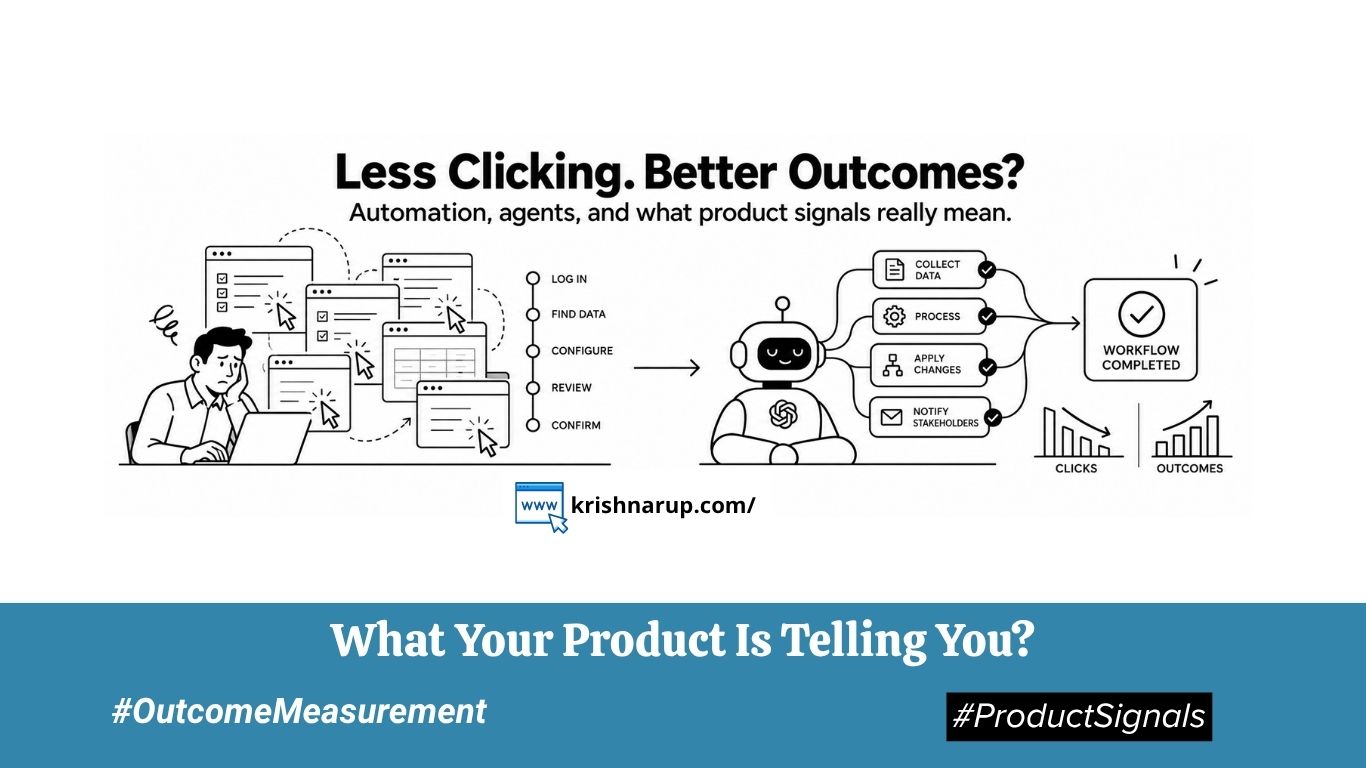
Your product analytics dashboard says engagement is down.
Fewer clicks.
Fewer screens opened.
Shorter sessions.
The obvious conclusion?
Something is wrong.
But what if your automation is actually working so well that customers simply don’t need to click anymore?
That is where traditional SaaS metrics can start lying to us.
And as more products introduce AI agents, automated workflows, copilots, and background processes, I think this distinction is going to matter a lot more.
Imagine hiring someone… then measuring how many times they walk to the filing cabinet
Let’s say you hire an operations manager.
Before they arrive, your team has to:
open five spreadsheets,
copy information between systems,
send three emails,
update a dashboard,
check for replies,
and follow up manually.
Twenty-five little actions just to finish one business task.
Then your new operations manager takes over.
Now you say:
“Get this done.”
And they do.
One request. One completed outcome.
Would you complain because the number of clicks inside your company’s systems dropped?
Probably not.
You’d probably celebrate.
Yet that’s exactly what can happen when we add automation to software.
The customer becomes less active inside the product because the product is doing more work for the customer.
That’s not necessarily lower engagement.
It may be higher value.
The problem is that SaaS trained us to worship activity
For years, product teams learned to watch metrics like:
- sessions
- clicks
- screen views
- time in product
- feature usage
- actions per user
And those metrics made sense.
Traditional software often required the user to perform the workflow themselves.
If someone stopped interacting with the product, they might actually be disengaging.
But automation changes the equation.
AI agents change it even further.
When software starts performing work instead of merely providing tools for work, interaction volume becomes a much weaker proxy for value.
A customer might previously need 18 interactions to complete something.
After automation?
Three.
Or one.
Eventually, perhaps none.
The software receives a trigger, executes the workflow, handles exceptions, and delivers the result.
If I only look at clicks, my dashboard might tell me engagement collapsed.
If I look at business outcomes, I may discover the opposite.
Clicks measure activity. Outcomes measure progress.
That distinction sounds simple.
But it changes how I think about product analytics.
Suppose a customer uses an accounts receivable platform.
Before automation:
Invoice opened → customer checked → reminder created → email written → follow-up scheduled → payment status checked → CRM updated.
Seven visible actions.
After automation:
Invoice becomes overdue → agent contacts customer → follows policy → escalates when necessary → updates CRM → payment arrives.
The user barely touches the application.
Now tell me:
Did engagement decrease?
Or did friction decrease?
Those are very different things.
I would start measuring workflow completion instead
When automation becomes part of a product, I want to understand something broader than feature usage.
I want to understand:
Did the customer successfully complete the job they came here to do?
That shifts analytics from:
“How much did they use the software?”
to:
“How effectively did the software help them achieve the outcome?”
For me, that means looking at metrics such as:
Workflow completion rate
What percentage of started workflows actually reach the intended outcome?
A customer may click half as much while completion rises from 65% to 92%.
That’s probably not a problem.
That’s progress.
Time to outcome
How long does it take from the beginning of a workflow to the result?
If automation reduces a two-hour task to four minutes, fewer interactions are exactly what I would expect.
Human intervention rate
How often does the automation require someone to step in?
This becomes especially important with AI agents.
If an agent completes 80% of workflows independently but requires manual rescue for the other 20%, that intervention rate tells me far more than page views.
Exception rate
Where does automation break?
Which cases consistently get escalated?
Which workflows fail?
Which customers still abandon the process?
This is where valuable product improvement signals often hide.
Outcome quality
Completion isn’t enough.
The workflow must also produce the right result.
An AI agent that completes 100 customer support tickets but resolves only 55% correctly isn’t performing well.
Automation without quality is just faster failure.
There is another metric I think deserves more attention: avoided work
This is an interesting one.
Product analytics traditionally measures what users did.
Automation introduces another question:
What did users no longer have to do?
Ten manual data-entry steps disappeared.
Three approvals were automatically routed.
Five follow-up emails were generated.
A reconciliation task that once required an analyst now runs automatically every night.
That eliminated work is part of the product’s value.
And yet most analytics dashboards barely capture it.
I think that will change.
But fewer clicks can still be bad
There is an important warning here.
I’m not suggesting every decline in engagement should be celebrated.
Sometimes fewer clicks really do mean customers are leaving.
The difference is whether outcomes improved at the same time.
If clicks fall and:
workflow completion falls,
retention declines,
customers reopen tasks,
error rates rise,
support tickets increase,
or users bypass the automation…
then you probably have a problem.
But if clicks fall while:
completion increases,
time-to-outcome improves,
manual intervention decreases,
quality remains high,
and customers continue paying…
then lower interaction may actually be one of your strongest product signals.
Agentic software makes this even more important
I believe this becomes especially interesting as SaaS evolves toward agent-driven interfaces.
The traditional model looks something like this:
User → UI → Feature → Result
But increasingly we may see:
User → Intent → Agent → Workflow → Result
The backend SaaS infrastructure may still exist.
The business rules still exist.
The integrations still exist.
The database still exists.
But the customer’s relationship with the software changes.
Instead of navigating the product, the customer delegates work to it.
And delegation naturally reduces interaction.
That means many product teams will need to rethink what “engagement” actually means.
Your dashboard should follow the customer’s job
Whenever I look at product analytics, I like to ask one simple question:
What is the customer actually trying to get done?
Not:
“What feature are they clicking?”
Not:
“How many minutes are they spending here?”
But:
“What progress are they trying to make?”
Then I work backward.
If the product exists to help sales teams qualify opportunities, measure qualified opportunities.
If it exists to automate compliance reviews, measure completed reviews and exception rates.
If it exists to reduce invoice processing time, measure processing time and successful completion.
If it exists to automate customer onboarding, measure onboarding completion and time-to-value.
Your metrics should reflect the customer’s destination — not how many buttons they pressed on the way there.
The dashboard I would want for an automated product
If I were evaluating an automation-heavy SaaS product, I would probably want four layers of signals.
1. Adoption
Are customers enabling and trusting the automation?
2. Workflow performance
Are automated workflows actually completing?
3. Outcome quality
Are those workflows producing correct and useful results?
4. Business impact
Is the automation reducing cost, saving time, increasing throughput, improving revenue, or lowering risk?
Clicks still matter.
Feature usage still matters.
Sessions still matter.
But they become supporting metrics.
Not the final verdict.
The bigger product question
There is a strange moment many SaaS companies may soon face.
They’ll build better automation.
Customers will spend less time inside their product.
Their traditional engagement dashboard will turn red.
And the team may panic.
But perhaps the customer isn’t disengaging.
Perhaps the customer is finally getting what they paid for.
Less software usage.
More work completed.
That’s a very different definition of product success.
A question for product leaders and founders
If your AI agent completed the customer’s entire workflow successfully while the customer barely opened your application…
would you call that low engagement or an excellent product experience?
I’m curious how others are thinking about this.
#ProductSignals
#AgentPerformance #WorkflowCompletion #OutcomeMeasurement
I help B2B SaaS founders and product teams understand what their product is actually telling them — from customer behavior and workflow performance to activation, adoption, retention, and AI-agent outcomes.
If your analytics dashboard is full of numbers but you’re still unsure what customers are doing, where they’re getting stuck, or what you should improve next, that’s exactly where I can help.
If you’d like to discuss your product analytics and optimization strategy reach out to me directly, click here .