
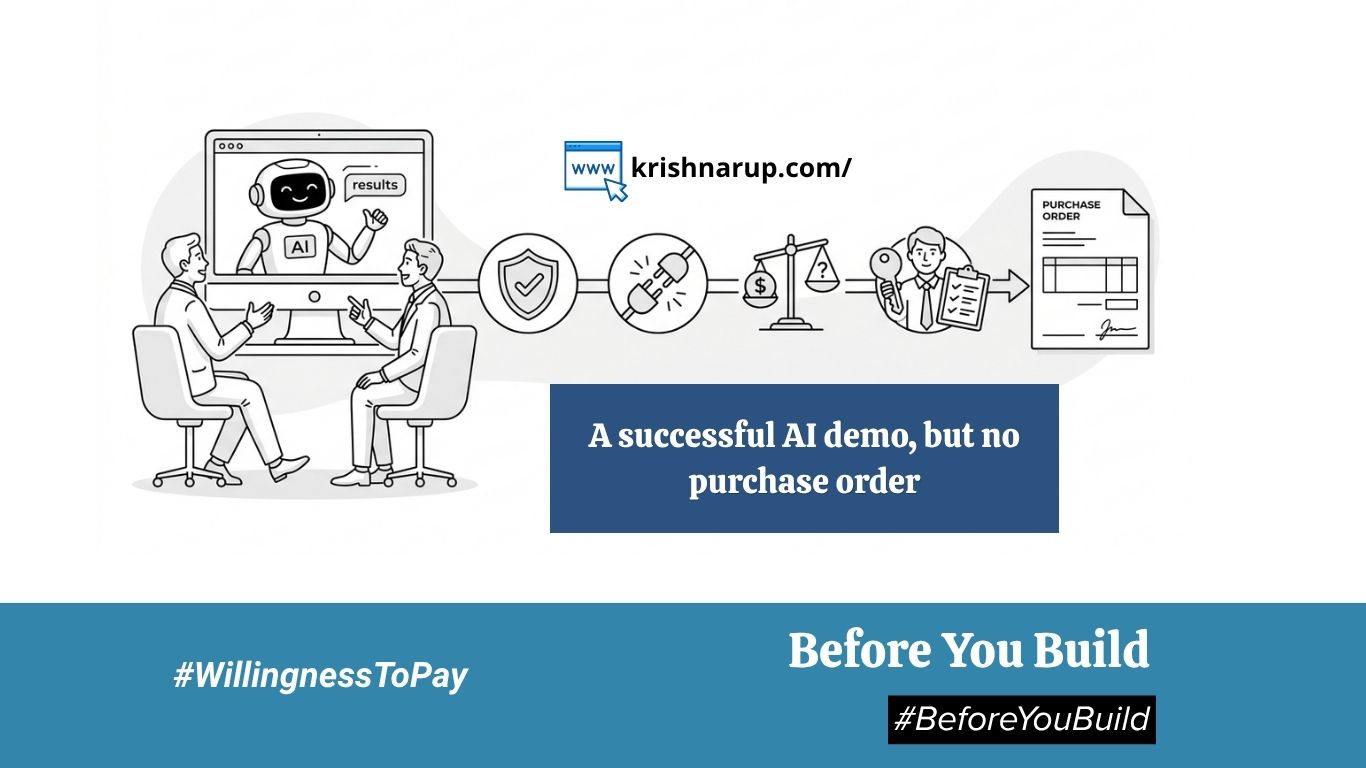
The AI demo worked perfectly. Everyone smiled. Someone even said, “This could change everything.”
Then nothing happened.
No pilot agreement.
No procurement call.
No purchase order.
Just a polite email two weeks later:
“We’re still discussing it internally.”
I’ve learned to treat that sentence carefully. It rarely means the buyer failed to understand the demo.
More often, the demo proved that the AI could do something impressive—but it did not prove that the company could safely, economically, and operationally depend on it.
That distinction is where many promising AI products get stuck.
And it is why, before I think about adding more features or making the next demo even more spectacular, I want to understand what remains unproven.
A test drive is not a fleet decision
Imagine taking a new truck for a test drive.
The engine sounds great. The steering is smooth. The salesperson demonstrates a parking feature that makes everyone in the vehicle grin.
But if you manage a delivery fleet, that is only the beginning of the buying decision.
You still need to know:
- Can it carry your normal load?
- Will it work with your routing and maintenance systems?
- What will it cost to operate across 50 vehicles?
- Who is responsible when it breaks down during a critical delivery?
The test drive proved that the truck moves.
It did not prove that the business should buy it.
An AI demo often works the same way.
It may prove that a model can summarize a document, answer a question, recommend an action, or complete a task under controlled conditions.
But the buyer is quietly evaluating a much larger system:
Trust. Integration. Economics. Ownership.
If those questions remain unanswered, the applause can be genuine—and the purchase order can still never arrive.
1. Trust: “Will it behave this well when the demo is over?”
A polished demonstration usually shows the happy path.
The data is clean. The prompt is understood. The tools respond. The answer looks confident.
Real work is not nearly so cooperative.
Customer records are incomplete. Policies contradict one another. A request arrives with missing context. An employee uses an abbreviation nobody documented. The obvious answer is wrong because this customer has a special contract.
This is why I don’t treat trust as a vague emotional objection. I treat it as a product requirement that must be investigated.
I want to know:
- Which errors would be merely inconvenient?
- Which errors could create financial, regulatory, operational, or reputational damage?
- Can users see the source or reasoning behind a recommendation?
- Can they correct the output without fighting the system?
- When is human approval mandatory?
- What happens when the AI is uncertain—or confidently wrong?
The strongest trust question is not, “Is the AI accurate?”
It is, “Is the entire workflow designed to remain dependable when the AI is imperfect?”
That may require citations, confidence indicators, approval thresholds, audit trails, exception handling, or a clear fallback process.
A buyer does not need magic.
They need a system they can supervise.
2. Integration: “Where does this fit into the work we already do?”
A demo can look powerful because it stands alone.
The customer’s business does not.
Their work may move through a CRM, an ERP, email, shared drives, spreadsheets, ticketing software, identity systems, approval chains, and a few unofficial workarounds nobody mentioned in the first meeting.
The AI may produce an excellent answer—but where does that answer go?
Who receives it?
What system must it update?
Which permissions does it need?
What happens if an integration is unavailable, a field has changed, or two systems disagree?
This is where customer discovery becomes more valuable than another scripted demo.
I want to watch how the work actually happens. Not how the process diagram says it happens. Not how the executive sponsor believes it happens. I want someone to show me a recent, real example from beginning to end.
The revealing moments are often small:
“Then I export this to Excel.”
“I message Sarah because only she knows which code to use.”
“We copy that field manually because the two systems don’t talk.”
Those sentences expose the real integration surface.
Sometimes the AI feature is valuable, but adopting it would require the customer to redesign five surrounding processes. That is no longer a simple feature purchase. It is a change program wearing a software price tag.
If I do not discover that early, the sales conversation will eventually discover it for me—usually much later and at a much higher cost.
3. Economics: “Does this create enough value to justify the full cost?”
“It saves time” is not yet a business case.
Whose time does it save?
How much?
How often?
What happens to that saved time?
And what new work does the AI create?
An agent might complete a task in two minutes instead of twenty. That sounds like an 18-minute saving.
But then an employee spends eight minutes checking the answer, three minutes correcting the formatting, and five minutes handling an exception the old process already knew how to manage.
The demo showed speed.
The workflow delivered a much smaller gain.
I want to examine the complete economic equation:
- Implementation and integration costs
- Model, infrastructure, and support costs
- Human review and exception-handling costs
- Training and process-change costs
- Risk reduction or risk introduced
- Revenue gained, loss avoided, or capacity created
- Time required before the customer sees measurable value
The best metric is rarely “number of AI actions completed.”
It is something the buyer already cares about: faster resolution, fewer errors, lower processing cost, shorter cycle time, greater throughput, better conversion, or reduced risk.
If I cannot connect the AI capability to a measurable business outcome, I may have an impressive feature—but not yet a compelling purchase.
4. Ownership: “Who carries the responsibility when the agent acts?”
This is the question that can quietly freeze a deal.
Suppose the AI drafts a recommendation. That may be easy to approve.
Now suppose it sends the message, updates the customer record, changes a price, routes a claim, rejects a request, or triggers a payment.
The value may increase because the AI is doing more.
So does the accountability.
Who owns the result?
The user who approved it?
The department using it?
The executive sponsor?
IT?
The vendor?
The employee whose work the agent performed?
And who owns the agent after launch?
Someone must monitor its performance, review exceptions, update rules, manage access, investigate failures, and decide when the system should be changed or paused.
If ownership is unclear, the customer may like the product and still be unable to adopt it.
This is not simply legal paperwork to address at the end. Ownership affects the product design itself.
It determines which actions need approval, what must be logged, which controls administrators require, how permissions work, and what evidence the system must preserve.
The demo asks, “Can the agent do this?”
The organization asks, “Who is accountable if it does?”
Both questions matter.
The demo may have validated the capability—not the product
This is the uncomfortable possibility I would want a founder to consider.
A successful demo may validate that:
- The model can perform the core task.
- The experience creates interest.
- The technical concept is feasible.
But it may not yet validate that:
- Users will trust it in messy, real conditions.
- It fits into the customer’s existing workflow and systems.
- The financial return justifies adoption and change.
- Responsibility for its decisions and operation is clear.
That does not mean the demo failed.
It means the demo answered one question—and the buying decision contains several more.
What I would test next
After a strong demo, I would resist the temptation to immediately add more AI capability.
Instead, I would turn the buyer’s remaining uncertainty into a validation plan.
I would choose one real workflow, with real users and representative data, and define:
- The business outcome: What measurable result should improve?
- The operating boundary: What may the AI recommend, and what may it do?
- The trust mechanism: How will users verify, correct, approve, or reject its work?
- The integration path: Which systems, permissions, and handoffs are required?
- The economic baseline: What does the current workflow cost in time, money, delay, and error?
- The owner: Who is accountable during the pilot and after deployment?
Then I would test the inconvenient cases—not only the impressive ones.
Give it incomplete information. Introduce an exception. Remove an integration. Ask a new employee to use it. Let an experienced user challenge the recommendation.
That is where a promising demonstration begins turning into a dependable product.
Before you build more, discover what the buyer still needs to believe
When a demo gets praise but no purchase order, the answer is not always a better demo.
Sometimes the real work is helping the customer believe four things:
We can trust it. It fits our operation. The economics make sense. Someone clearly owns the outcome.
That is why I see customer discovery as more than asking people whether they like an idea.
It is the process of uncovering what must be true for a customer to buy, adopt, and continue using the product.
The applause tells me I have attention.
The unanswered questions tell me what I need to validate next.
If your AI demo is generating interest but not moving into pilots or purchase decisions, I help turn that uncertainty into a structured product-validation roadmap—covering the workflow, business case, requirements, risks, and path to adoption.
If you want to examine what remains unproven before investing in the next build, reach out to me directly, click here.
And I’d genuinely like to hear from founders, buyers, and product leaders:
What has stopped an impressive AI demo from becoming a real purchase inside your organization—trust, integration, economics, ownership, or something else entirely?
#BeforeYouBuild #CustomerDiscovery #ProcurementReadiness #WillingnessToPay