
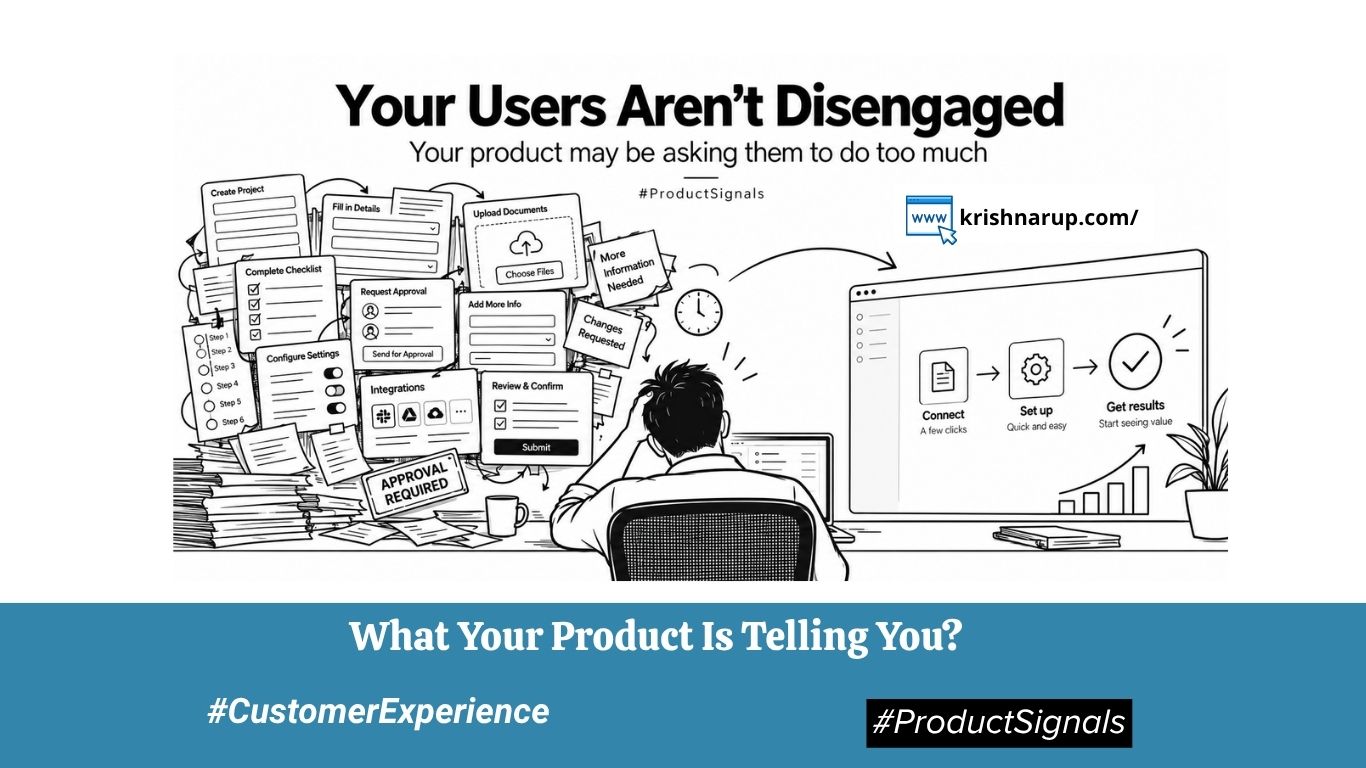
Your Users Aren’t Disengaged. Your Product May Simply Be Asking Them to Do Too Much.
There’s a conversation I think almost every SaaS founder eventually has.
Someone pulls up the dashboard.
“Engagement is down.”
Fewer sessions.
Fewer clicks.
Users aren’t exploring as many screens.
Maybe feature adoption isn’t where the team expected it to be.
And within a few minutes, the room starts filling with explanations.
“We need better onboarding.”
“We should send more reminders.”
“Maybe we need gamification.”
“Should we redesign the dashboard?”
“Marketing might be bringing in the wrong users.”
“We probably need another feature.”
Maybe.
But there’s another question I’d ask before touching the roadmap:
What if your users aren’t disengaged?
What if your product is simply asking them to do too much?
That distinction matters.
A lot.
Because if you misdiagnose workflow friction as lack of engagement, you can spend the next two quarters trying to persuade customers to interact more with a product they actually wish they could interact with less.
And that is a very different product problem.
We’ve trained ourselves to treat activity as success
SaaS teams have spent years learning to measure engagement.
Daily active users.
Weekly active users.
Sessions.
Clicks.
Screen views.
Feature adoption.
Time in product.
Frequency of use.
Those metrics absolutely have value.
But they become dangerous when we quietly make this assumption:
More interaction = more value.
That isn’t always true.
Think about the software you personally use to run a business.
Do you wake up hoping to spend another 45 minutes inside your accounting software?
Do you want your payroll platform to give you more screens to explore?
Would you be excited if your CRM required eight steps instead of three to update an opportunity?
Probably not.
For a large category of B2B products, customers aren’t buying software because they want software.
They’re buying an outcome.
They want the invoice sent.
The report generated.
The lead routed.
The employee onboarded.
The inventory reconciled.
The support ticket resolved.
The compliance check completed.
The contract approved.
The workflow finished.
The customer rarely says:
“I wish your product gave me more things to click.”
They say:
“Can you make this easier?”
That is a completely different lens for product analytics.
Sometimes fewer clicks are the better product signal
Imagine you run a B2B SaaS platform and customers historically needed 14 actions to complete an important workflow.
Your team redesigns it.
Now the same workflow takes five actions.
What happens to your engagement metrics?
Clicks go down.
Time in product may go down.
Screen views may go down.
The number of steps completed per session may go down.
Viewed through an old-fashioned engagement dashboard, you could conclude:
Users are becoming less engaged.
Viewed through the customer’s eyes?
You may have just dramatically improved the product.
This is why I become cautious whenever I hear a team say:
“Engagement dropped.”
My next question is:
What happened to the customer’s outcome?
Did completion increase?
Did time-to-value fall?
Did error rates decline?
Did users abandon the workflow less often?
Did support tickets decrease?
Did customers accomplish the job faster?
Did more accounts reach the intended business outcome?
Because a product can have less interaction and more value at exactly the same time.
The product may be charging an “effort tax”
Every product asks users to pay something.
Not just money.
It asks for attention.
Memory.
Clicks.
Data entry.
Decision-making.
Learning.
Context switching.
Configuration.
Waiting.
Interpretation.
Coordination with coworkers.
I think of that as the effort tax of using the product.
Some effort is unavoidable.
But over time, products have a habit of accumulating unnecessary effort.
One customer asks for a setting.
Another customer asks for an approval step.
Sales requests another configuration option.
Compliance adds another field.
Product adds another notification.
Engineering exposes another control.
A major customer wants another workflow variation.
None of these decisions necessarily looks terrible on its own.
Then three years later, a user trying to perform what should be a simple job is staring at:
17 fields.
Six dropdowns.
Four tabs.
Three approval states.
Two confirmation screens.
And one tooltip explaining why another tooltip exists.
Then the product team wonders why users aren’t “engaging.”
Maybe they’re exhausted.
B2B SaaS can quietly become organizational bureaucracy in software form
This is especially important in B2B.
Consumer software frequently competes for attention.
Business software often competes for efficiency.
That difference matters.
Your customer’s employee isn’t necessarily opening your application because they love your interface.
They’re opening it because something needs to get done before lunch.
That person may already have:
Slack.
Email.
A CRM.
An ERP.
A ticketing system.
A spreadsheet.
An internal dashboard.
A project management platform.
Three browser tabs containing information your software doesn’t have.
And probably a meeting starting in 11 minutes.
Now your product asks them to manually copy information between five screens.
Technically, they’re “using the product.”
But from their perspective?
Your product has become another piece of work.
This is where engagement data needs interpretation, not just measurement.
The real question isn’t “Are they using it?”
I prefer a different set of questions.
What were they trying to accomplish?
How much effort did we require?
Did they actually complete the job?
How quickly did they reach the outcome?
Did they have to leave our product to finish the workflow?
Did they need another person to help them?
Did they come back because our product created value—or because the process wasn’t finished?
That last question is worth sitting with.
Because repeat usage is not always a compliment.
Sometimes users return because they love the product.
Sometimes they return because the product made them come back.
Those are not the same thing.
A “healthy” engagement metric can hide a broken workflow
Here’s an example.
Suppose you sell software that helps operations teams reconcile transactions.
The average customer logs in five times per week.
Great engagement, right?
Maybe.
Now you talk to customers and discover why.
They upload the file Monday.
The system flags exceptions Tuesday.
They export them into Excel.
They email the spreadsheet to Finance.
Finance makes corrections.
Operations reuploads the file.
The system rejects three rows.
They fix those manually.
Then they return Friday to complete reconciliation.
Five sessions.
Wonderful dashboard.
Terrible workflow.
Now imagine you redesign the product so Finance and Operations can resolve exceptions directly in the system.
Five sessions become two.
Time in product drops 40%.
Pageviews decline.
But the reconciliation is completed two days earlier.
Did engagement deteriorate?
Or did the product finally start doing its job?
This is where product analytics becomes product judgment.
The dashboard gives you signals.
It doesn’t make the decision for you.
Watch for “effort signals,” not just engagement signals
If I were diagnosing this with a founder or product team, I wouldn’t look only at traditional engagement.
I’d start looking for evidence of unnecessary effort.
Some signals are quantitative.
Some are qualitative.
The interesting part is when several begin pointing in the same direction.
For example:
Repeated navigation between the same screens
Users may be hunting for information rather than progressing through a workflow.
High activity with low completion
Lots of clicks don’t matter if the core job isn’t getting finished.
Long time-on-task
In content products, longer time can be positive.
In operational software, it can mean friction.
Repeated editing
Users continually changing the same information may indicate unclear requirements, poor defaults, or broken workflow logic.
Excessive exports
If customers constantly export your data to spreadsheets, they may be telling you:
“The analysis or decision I need to make cannot be completed here.”
That’s not merely an export event.
That’s a product signal.
Excessive copy-and-paste behavior
Your application may sit inside a larger workflow that you’ve failed to understand.
Abandonment immediately before a key step
Maybe users aren’t losing interest.
Maybe you’ve made the next step too expensive cognitively or operationally.
Heavy support dependency
If users repeatedly contact support to complete routine workflows, support may be functioning as an undocumented part of your UI.
Feature discovery without feature completion
Users found the feature.
So discoverability may not be the problem.
Something after discovery is stopping them.
That changes the diagnosis completely.
Ask where the user has to think
One question I’ve found useful when looking at workflows is:
Where are we forcing the user to stop and think?
Not all thinking is bad.
Some products help people make complicated decisions.
But unnecessary decision-making creates friction surprisingly quickly.
Consider these two experiences.
Product A asks:
Select your synchronization configuration.
Product B says:
We found 2,418 records. We’ll sync new customers every 15 minutes. You can change this later.
Same capability.
Completely different cognitive load.
One product transfers the decision to the user.
The other product makes a reasonable decision and allows the user to override it.
That pattern matters.
As software becomes more capable—particularly with AI and agentic workflows—I think one of the biggest product opportunities will be identifying decisions the user no longer needs to make manually.
Not because we want to remove human judgment.
Because humans shouldn’t spend judgment on decisions the system can make safely and reversibly.
This is where AI gets interesting
The AI conversation in SaaS is often framed around adding intelligence.
I think the more interesting question is often:
What work can disappear?
Imagine a sales operations product.
The traditional workflow might ask the user to:
- Open the opportunity.
- Review activity history.
- Check email engagement.
- Review stakeholder roles.
- Compare deal stage.
- inspect previous notes.
- Identify missing information.
- Decide whether the deal is at risk.
- Update the CRM.
- Create a follow-up task.
Then someone says:
“Let’s add an AI copilot.”
So now there are eleven steps.
We added AI.
But we didn’t redesign the workflow.
A more interesting product question might be:
Why can’t the system analyze those signals, surface the three accounts requiring attention, explain why, recommend the action, and let the rep approve it?
Now we’re not adding another feature.
We’re removing work.
That’s a different product philosophy.
Your users may not want another feature
This is a hard conversation inside many SaaS companies.
Because features are visible.
Removing effort is often less visible.
A new dashboard looks impressive in a demo.
A workflow that goes from 12 steps to four?
It might look almost boring.
But boring can be commercially powerful.
Customers don’t necessarily pay for the number of features you’ve built.
They pay for the business capability those features create.
And that means sometimes the best roadmap question isn’t:
What should we add next?
It’s:
What can the customer stop doing?
That question can lead you somewhere very different.
Measure “distance to value”
When I think about product signals, one useful concept is what I’d call distance to value.
How far does the user need to travel between intent and outcome?
For example:
“I need to understand why churn increased.”
How many steps until the product answers that question?
“I need to create this month’s board report.”
How much work between opening the application and having the report?
“I need to onboard this customer.”
How many fields, approvals, integrations, and handoffs stand between those two points?
“I need to know which accounts are at risk.”
Does the product provide an answer?
Or does it provide five dashboards that the customer must interpret before producing the answer themselves?
The shorter the distance between intent and useful outcome, the stronger the product often becomes.
But be careful: less engagement isn’t automatically good either
There’s an important counterpoint here.
We shouldn’t simply reverse the old assumption.
More engagement isn’t always good.
But less engagement isn’t automatically good either.
If customers stop using the product because they stopped receiving value, that’s obviously a problem.
The goal isn’t fewer clicks.
The goal is better outcomes with appropriate effort.
That’s why product signals have to be interpreted together.
If usage falls while:
completion falls,
retention weakens,
support complaints increase,
expansion slows,
and customers stop reaching key outcomes…
you probably have an engagement problem.
But if usage falls while:
workflow completion rises,
time-to-value improves,
errors decline,
customer satisfaction improves,
retention strengthens,
and customers reach outcomes faster…
the reduced activity may be evidence that you’ve built a better product.
Same metric.
Completely different story.
Founders need to distinguish behavior from meaning
This is where I think founders can get trapped by analytics.
Analytics tells you what happened.
Product leadership has to determine what it means.
A 25% decline in clicks is an observation.
It is not yet a conclusion.
A drop in session frequency is an observation.
It is not yet a product decision.
A feature adoption rate of 18% is an observation.
It doesn’t automatically tell you whether you should improve, reposition, redesign, automate, bundle, or kill the feature.
Those decisions require context.
Customer intent.
Workflow.
Segment.
Business outcome.
Buying behavior.
Retention.
Commercial value.
Product strategy.
That’s why I like the term product signals rather than simply product metrics.
A signal is something you interpret.
If your engagement is declining, investigate these five things
Before launching another onboarding campaign or adding another feature, I’d investigate five areas.
1. Outcome
What job was the customer actually trying to complete?
Not:
“What feature were they using?”
Ask:
“What were they trying to get done?”
Features are implementation.
Outcomes are value.
2. Effort
How much work did we require to produce that outcome?
Count more than clicks.
Look at:
decisions,
fields,
handoffs,
waiting,
configuration,
manual research,
copying data,
exports,
approval steps,
and switching between tools.
You may discover that the user isn’t disengaged.
They’re simply protecting their time.
3. Completion
Did they successfully finish the workflow?
A product with 80% feature adoption and 45% workflow completion may have a bigger problem than a product with 40% feature adoption and 90% completion.
Usage isn’t the finish line.
Value is.
4. Repetition
Why are users coming back?
Because the product is valuable?
Because the workflow naturally repeats?
Or because yesterday’s task still isn’t complete?
Those scenarios may produce similar engagement charts but require completely different product decisions.
5. Business impact
What happens after the user completes the workflow?
Does revenue move?
Does cost decline?
Does risk decrease?
Does something happen faster?
Does the customer retain more customers?
Does an employee save time?
Does a team make a better decision?
The closer your product telemetry gets to the customer’s business outcome, the more useful your product analytics becomes.
The opportunity may be subtraction
There’s a natural tendency in SaaS to respond to growth pressure with addition.
Add features.
Add workflows.
Add notifications.
Add dashboards.
Add AI.
Add configuration.
Add another pricing tier.
But mature product thinking sometimes moves in the opposite direction.
Remove a decision.
Remove a screen.
Remove duplicate data entry.
Remove an unnecessary approval.
Remove configuration.
Remove a handoff.
Remove a report somebody generates manually.
Remove the need to open the product at all.
That last one may sound uncomfortable.
But imagine your product detects an issue, resolves it safely, documents what happened, and notifies the right person only when human judgment is necessary.
The user interacted less.
The product delivered more.
That’s not weak engagement.
That’s leverage.
The product question I’d take into your next leadership meeting
If you’re a founder, CEO, product leader, or investor looking at a SaaS business, here’s the question I’d put on the whiteboard:
“What work are our customers doing today that our product should eventually make unnecessary?”
Then look at your product data again.
Those “low engagement” numbers may start telling a different story.
Maybe customers don’t need another email reminding them to come back.
Maybe they don’t need another tutorial.
Maybe they don’t need a redesigned navigation bar.
Maybe they don’t need another dashboard.
Maybe they need the product to take more of the workload off their shoulders.
Because ultimately, customers rarely buy B2B software to become better at using software.
They buy it to become better at running their business.
And sometimes the strongest product signal isn’t that customers want to spend more time with you.
It’s that they trust your product to give them more of their time back.
One question for founders
Take the most important workflow in your product.
If the customer currently needs 12 actions to complete it:
How many of those 12 genuinely require the customer?
Not how many your current architecture requires.
Not how many your original product spec required.
Not how many have “always been there.”
How many actually require human judgment?
I’d be curious what you find.
Because your next growth opportunity may not be another feature.
It may be removing five things your customers should never have been asked to do in the first place.
If this is the kind of product decision you’re working through
I work with B2B SaaS founders who are trying to turn customer evidence, product behavior, business priorities, and market realities into clearer product decisions.
There are three ways we can work together, depending on how much product leadership you need:
1. Product Decision Sprint
If you’re stuck on one important decision—activation, retention, roadmap priorities, an overloaded MVP, product-market alignment, customer validation, AI/agentic SaaS decisions, or positioning—we can work through it as a focused engagement.
The goal isn’t another deck.
It’s to get to the decision, the evidence behind it, and a practical 30–90 day path forward.
2. Fractional CPO
If product decisions keep coming back to you as the founder and you need ongoing senior product leadership, I can step into the product seat alongside you.
That can include product strategy, roadmap prioritization, customer evidence, product signals, Product × GTM alignment, quarterly planning, and the operating cadence needed to keep product decisions moving.
3. Founder Product Advisory
If you want to remain the product owner but would value experienced product judgment alongside you, we can work through key decisions in a lighter advisory relationship.
You keep ownership.
I help challenge assumptions, interpret evidence, pressure-test priorities, and work through the tradeoffs with you.
If your analytics dashboard is telling you “engagement is falling,” but you’re not convinced you understand why, that’s a conversation worth having.
Bring me the product decision you’re stuck on.
And if you’re a founder, operator, investor, or product leader reading this, I’d also like to hear your perspective:
What matters more in your product—more user engagement, or less user effort?
I suspect the answer is going to depend heavily on what your customer actually hired the product to do.
Krishnarup Banerjee
Fractional CPO | B2B SaaS
Business Problem → Product → Market → Growth