
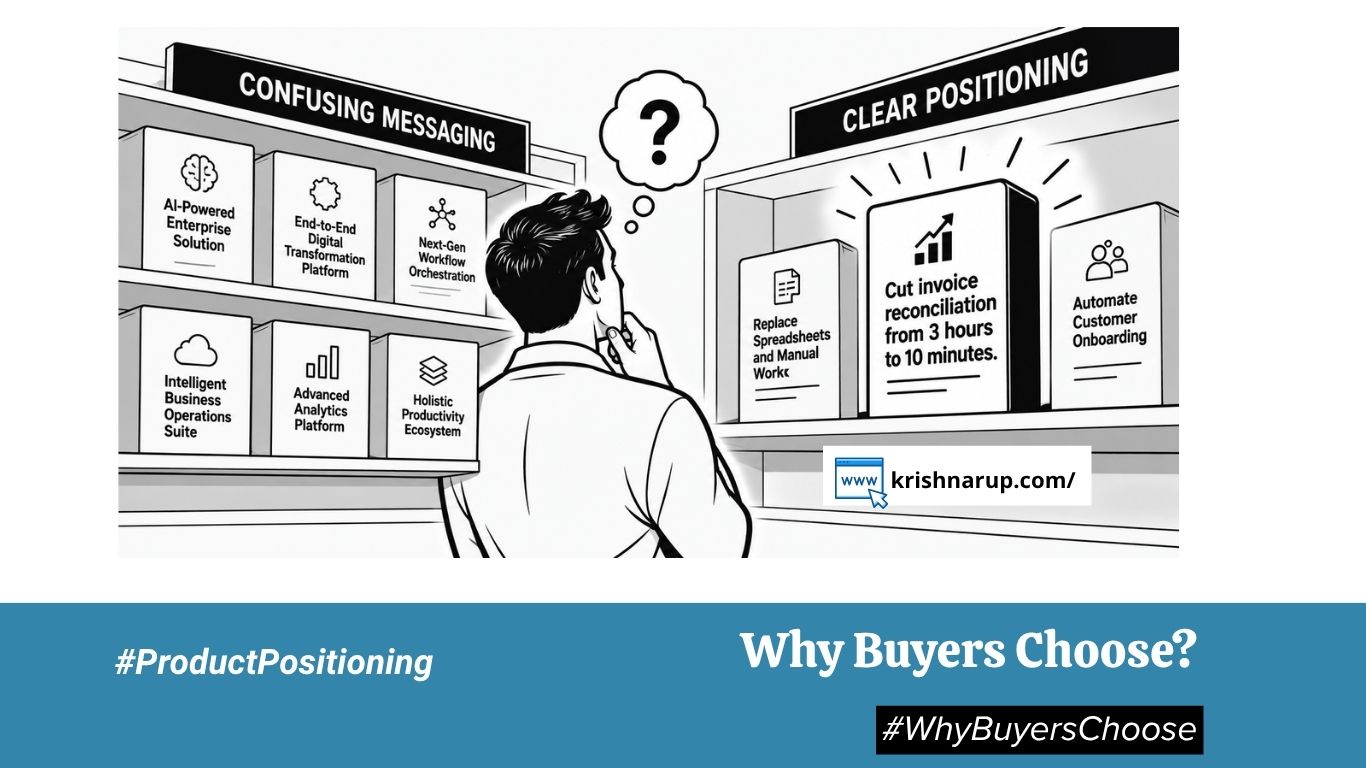
A buyer lands on your website.
They read the headline.
Then the subheadline.
Then the feature list.
Then they scroll back up.
And somewhere around 20 seconds later, one uncomfortable question appears in their head:
“So… what exactly is this?”
That may be one of the most expensive questions in B2B SaaS.
Not because your product is bad.
Not because the technology is weak.
Not because your team forgot an important feature.
But because the buyer still hasn’t figured out where your product belongs in their world.
That is a positioning problem.
And I see founders underestimate it all the time.
Your Product Already Has a Position
Imagine walking into a grocery store looking for coffee.
You know roughly where to go.
There’s an aisle.
There’s a shelf.
There are categories.
Premium roast.
Instant coffee.
Organic.
Decaf.
Single-origin.
Budget.
Now imagine somebody places a beautifully designed bag in the middle of the store with this written on it:
“An intelligent beverage experience designed to optimize your morning performance.”
Interesting?
Maybe.
But is it coffee?
Tea?
Protein powder?
An energy supplement?
That confusion is exactly what weak product positioning creates.
The product exists.
The benefits may be real.
But the buyer doesn’t know which mental shelf to put it on.
And buyers rarely purchase things they cannot categorize.
Positioning Is Not Your Tagline
This is where the conversation often gets messy.
A founder tells me:
“We need better positioning.”
Then the discussion immediately becomes:
“What should our homepage headline say?”
But positioning comes before messaging.
Your headline is the sign outside the restaurant.
Positioning is deciding what restaurant you actually are.
Italian?
Steakhouse?
Fast casual?
Fine dining?
Family restaurant?
If you haven’t decided that, polishing the sign won’t solve much.
You’ll just communicate the confusion more elegantly.
The Buyer Is Running a Comparison in Their Head
When founders talk about their product, they naturally start with the product.
“We use AI.”
“We automate workflows.”
“We have advanced analytics.”
“We integrate with 40 platforms.”
“We reduce manual effort.”
All useful.
But buyers are usually asking a different set of questions.
What does this replace?
What category does this belong to?
Why would I use this instead of what I already have?
Why does this matter now?
Why should I trust this company?
That is why positioning cannot simply describe what your software does.
It must help buyers understand how to think about your software.
Your Biggest Competitor May Be “Doing Nothing”
Founders often create competitive matrices.
Competitor A.
Competitor B.
Competitor C.
Then they carefully mark the boxes:
✅ Our feature
❌ Their feature
✅ Our AI capability
❌ Their automation
But the competitor I often find more interesting isn’t on the spreadsheet.
It is:
“We already handle this manually.”
Or:
“Our operations team built a workaround.”
Or:
“We use spreadsheets.”
Or simply:
“This isn’t painful enough to change yet.”
That changes the positioning conversation.
Because now your job isn’t simply proving that your software is better than another software product.
You may first need to prove that the buyer’s current way of working has become too expensive, too slow, too risky, or too limiting.
Positioning starts with understanding that status quo.
I Like to Start With Five Questions
When I work through product positioning, I prefer to strip away the marketing language first.
I want simple answers.
1. Who is this product specifically for?
Not:
“SMBs.”
Not:
“enterprises.”
Not:
“businesses looking to improve productivity.”
Who actually feels the pain?
Who owns the problem?
Who searches for a solution?
Who approves the purchase?
Those can be different people.
The narrower this becomes, the clearer everything downstream becomes.
2. What painful situation puts them in the market?
This is different from asking what your product does.
A buyer rarely wakes up thinking:
“I need a sophisticated workflow orchestration platform.”
They wake up thinking:
“We’re losing three hours every day reconciling this manually.”
Or:
“Our customer onboarding has become a mess.”
Or:
“We’re paying five people to maintain something that should run automatically.”
That situation is the doorway into your product.
3. What are they using instead?
This is critical.
Maybe the alternative is another SaaS platform.
But maybe it is:
Excel.
Email.
Slack.
An internal tool.
An outsourced service provider.
A junior employee.
A senior employee doing junior work.
Or a workflow held together with copy-paste and institutional memory.
Positioning becomes much stronger when you understand what your product is replacing.
4. What outcome changes after they buy?
Features describe your product.
Outcomes describe the buyer’s future.
Instead of:
“AI-powered dashboard.”
Maybe the outcome is:
“Managers identify operational bottlenecks before they become customer escalations.”
Instead of:
“Automated workflow engine.”
Maybe:
“A process that once required three people and two days now moves automatically.”
Same technology.
Very different positioning.
5. Why should they choose you?
This is where many SaaS websites become interchangeable.
Everyone is:
Fast.
Secure.
Scalable.
AI-powered.
User-friendly.
Enterprise-ready.
Those are expectations, not necessarily differentiation.
The better question is:
What makes your approach meaningfully different for this specific buyer and this specific problem?
Maybe you understand an industry workflow competitors don’t.
Maybe deployment is dramatically easier.
Maybe your product replaces multiple tools.
Maybe your architecture enables something others can’t.
Maybe your pricing model aligns better with customer outcomes.
Maybe you focus on a narrow problem competitors treat as a secondary feature.
Your positioning lives somewhere inside those differences.
Strong Positioning Creates a Chain Reaction
When positioning becomes clear, something interesting happens.
A lot of other decisions get easier.
Your homepage becomes easier to write.
Your sales team knows what story to tell.
Your product roadmap becomes more disciplined.
Your marketing topics become clearer.
Your demos become more focused.
Your pricing starts making more sense.
Even customer qualification improves because people can quickly understand whether the product is meant for them.
That is why I don’t treat positioning as a copywriting exercise.
I treat it as a product strategy decision.
Because positioning affects what you build, who you build for, how you sell it, and how the market interprets everything you do.
Here Is a Simple Positioning Exercise
Try completing this sentence without using buzzwords:
For [specific buyer] who struggles with [specific problem], our product helps them [specific outcome] by [distinct approach], instead of [current alternative].
For example:
For operations teams managing complex customer onboarding, our platform reduces manual handoffs by orchestrating the workflow automatically, instead of coordinating the process across spreadsheets, email, and internal checklists.
It may not become your final homepage copy.
That is not the point.
The exercise forces clarity.
And clarity is the raw material of good positioning.
The Market Rarely Rewards the Product That Explains the Most
It often rewards the product that is easiest to understand.
Think about a crowded highway.
Every company is driving past the buyer holding a billboard.
One says:
“AI-powered end-to-end intelligent enterprise transformation platform.”
Another says:
“Cut invoice reconciliation from three hours to ten minutes.”
Which one do you remember?
Positioning isn’t about making the product sound bigger.
Sometimes the strongest positioning makes the product sound smaller, clearer, and more specific.
That can feel uncomfortable to founders.
Because narrowing the message feels like excluding potential customers.
But trying to sound relevant to everyone often creates a stranger outcome:
You become memorable to no one.
Before Adding More Features, Ask a Different Question
If prospects keep asking:
“What exactly do you do?”
If demos get positive reactions but few purchasing conversations.
If people visit your site but don’t immediately understand why the product matters.
If sales conversations require ten minutes of explanation before the buyer “gets it.”
I wouldn’t immediately assume you need another feature.
I would ask:
Does the market understand where this product belongs?
Because sometimes the product doesn’t need more functionality.
It needs a clearer place in the buyer’s mind.
And once that place becomes clear, everything from messaging to GTM gets easier.
That is why product positioning sits at the heart of my #WhyBuyersChoose work.
I help B2B SaaS founders connect the dots between:
Business Problem → Product → Market → Growth
If you’re building a SaaS product but struggling to explain why buyers should choose it, what position it should occupy, or how that positioning should translate into product and GTM decisions, reach out to me directly at click here.
And for everyone building, selling, advising, or investing in SaaS:
What’s harder in your experience—building a differentiated product, or making the market understand why it’s different?
I’d genuinely like to hear how you’ve seen this play out.
#WhyBuyersChoose #ProductPositioning #B2BSaaS #ProductStrategy #SaaS #GoToMarket #Founders #Positioning